What Is RTP in Online Slots? A Beginner's Guide
Published 2026-11-09
What Is RTP in Online Slots? A Beginner's Guide
If you've ever looked at the information page of an online slot, you may have noticed a percentage called RTP.
Some games display 94%, others 96%, and some show different values depending on the game configuration.
But what does that percentage actually mean? And does a slot with 96% RTP return $96 every time someone wagers $100?
The short answer is no.
Understanding RTP can help players interpret how online slots are designed, recognise misleading claims, and avoid confusing long-term mathematical averages with personal results.
In this guide, MIKTOP explains RTP in straightforward terms.
What Does RTP Mean?
RTP stands for Return to Player.
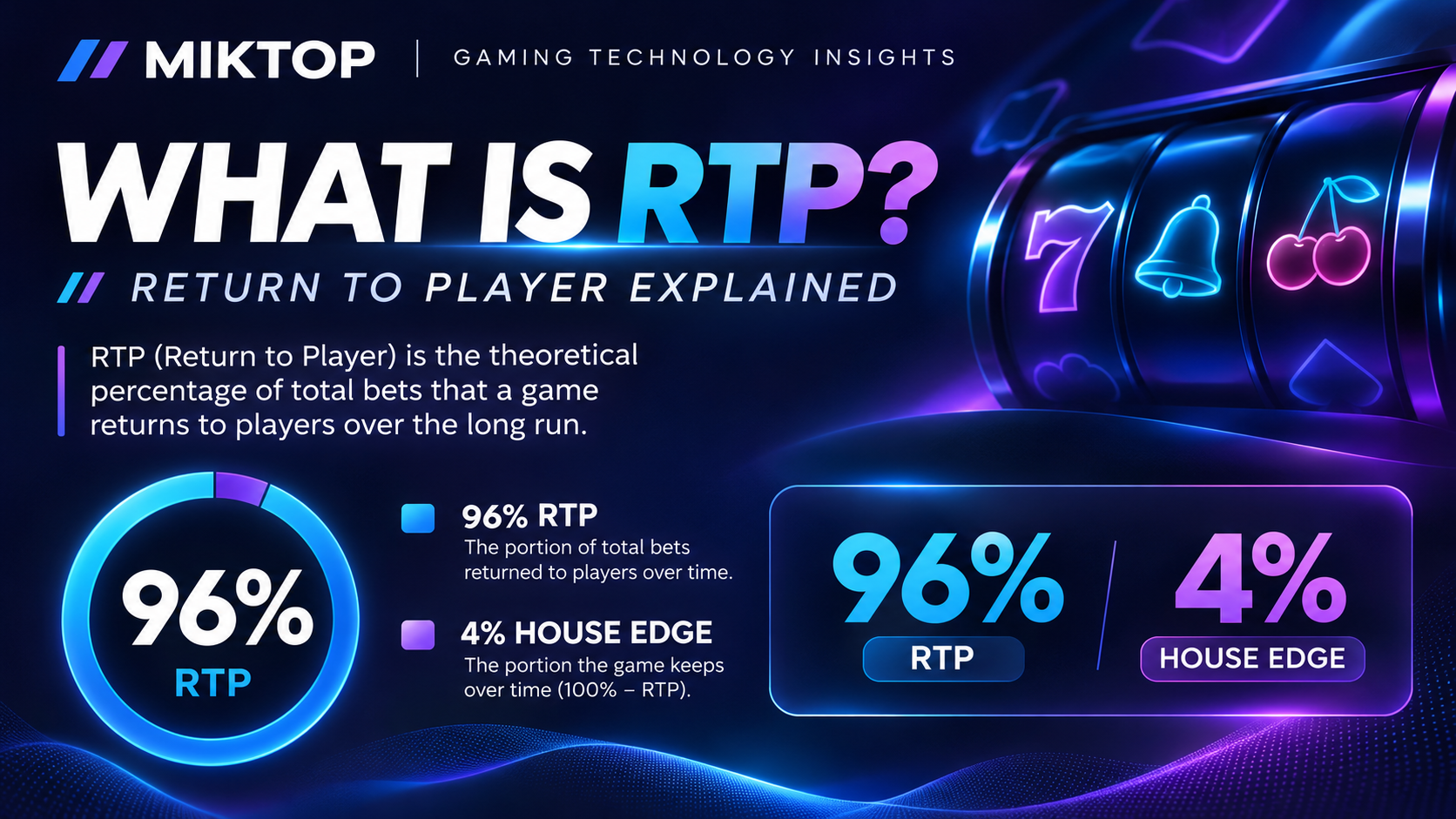
It is a theoretical percentage describing the proportion of total wagers that a game is designed to pay back over a very large number of rounds.
For example, a slot with a theoretical RTP of 96% is designed to return an average of $96 for every $100 wagered over a sufficiently large volume of play.
That does not mean a player who deposits $100 will finish with $96.
It also does not mean the game returns 96 cents on every dollar wagered.
Individual outcomes can vary significantly, and a player can lose their entire balance or experience a winning session.
RTP describes the game's mathematical design, not a guaranteed personal result.
How Is RTP Calculated?
The basic formula is:
RTP = (Total Amount Paid Out ÷ Total Amount Wagered) × 100
Imagine a game receives $1,000,000 in total wagers and pays out $960,000.
Its observed RTP for that sample is:
($960,000 ÷ $1,000,000) × 100 = 96%
However, an important distinction exists between theoretical RTP and observed RTP.
Theoretical RTP is calculated from the game's mathematical model, including the probabilities and payouts of its possible outcomes.
Observed RTP is calculated from the actual results recorded during a particular period or sample of play.
Observed RTP may be higher or lower than the theoretical figure, especially when the sample is small.
Does 96% RTP Mean You Lose Only 4%?
Not necessarily.
A theoretical RTP of 96% corresponds to a 4% house edge when measured as a percentage of total wagers under the game's stated mathematical model.
That is a long-run expected relationship, not a limit on how much an individual can lose.
Consider someone who starts with $100 and makes 100 spins at $1 each.
Their total amount wagered is $100.
Even with a theoretical RTP of 96%, the player is not guaranteed to receive $96 in payouts. Their actual results could be much lower or much higher.
There is another important distinction: deposits and total wagers are not the same thing.
If a player deposits $100, wins some money, and continues playing, they may wager several hundred dollars in total before stopping.
RTP applies to total wagering activity, not simply to the initial deposit.
RTP vs House Edge
RTP and house edge describe opposite sides of the same long-run mathematical relationship.
For a game with a fixed theoretical RTP:
House Edge = 100% − RTP
| Theoretical RTP | House Edge |
|---|---|
| 98% | 2% |
| 97% | 3% |
| 96% | 4% |
| 95% | 5% |
| 94% | 6% |
A higher RTP generally means a lower theoretical house edge.
However, it does not guarantee that one player will lose less during a particular session.
The number of rounds played, bet sizes, payout structure, and random variation all influence actual results.
RTP vs Volatility: What's the Difference?
RTP and volatility are often confused, but they describe different characteristics of a slot.
RTP describes the game's theoretical average return over a very large number of rounds.
Volatility, sometimes called variance in informal gaming discussions, describes how unevenly wins and losses may be distributed.
For example, two slots could both have a theoretical RTP of 96%.
One might produce relatively frequent smaller wins.
The other might produce fewer wins, with more of its theoretical return concentrated in occasional larger payouts.
Both can have the same RTP while creating very different short-term experiences.
This is why RTP alone does not tell a player how frequently they will win or how much they might lose in a session.
Can RTP Change Between Online Casinos?
Yes. Some slot titles are offered in multiple approved mathematical configurations with different theoretical RTP values.
For example, a game developer may supply versions of a title with different return percentages, depending on the product and market.
This means two websites displaying the same game title may not necessarily be offering the same RTP configuration.
However, not every slot has multiple configurations, and the available settings depend on the developer, operator, and applicable regulatory requirements.
Where information is provided, players can look for the theoretical RTP in the game's help section, paytable, or official information screen.
A figure found on an unrelated review website may not match the configuration being offered.
Can You Improve RTP by Changing Your Strategy?
For a standard RNG-based slot with fixed game rules and a fixed mathematical configuration, changing the timing of spins or following betting patterns does not increase its theoretical RTP.
Common ideas include:
- Increasing bets after losses.
- Switching games after a winning streak.
- Playing at particular times of day.
- Waiting for a slot to become ready to pay.
These approaches do not change the underlying mathematical return of an independent-spin slot.
Some games include optional features or betting modes that can change the mathematical characteristics of play. Those should be assessed according to the specific game's published rules rather than assumed to improve RTP.
A betting system cannot eliminate a built-in house edge.
How Does RTP Relate to RNG?
RTP and RNG serve different purposes.
An RNG (Random Number Generator) helps generate the random values used to determine individual game outcomes.
RTP (Return to Player) describes a long-run mathematical characteristic of the game.
Think of it this way:
RNG helps determine which outcome happens on a particular round.
RTP helps describe the average return built into the game's mathematical model.
A properly functioning RNG does not track a player's personal losses and deliberately award a win to bring that player's balance back towards the published RTP.
A theoretical return percentage is not an individual repayment target.
For a more detailed explanation, read MIKTOP's guide: How RNG Works in Online Games: A Beginner's Guide.
Is Higher RTP Always Better?
A higher theoretical RTP means a lower expected house edge under comparable conditions.
But it does not automatically mean a game is safer, more predictable, or likely to produce a winning session.
A high-RTP slot can still produce substantial losses, including losing streaks and rapid balance depletion.
Volatility, bet size, playing time, and the player's financial limits remain relevant.
Even a game with a relatively high RTP is generally designed with a mathematical advantage for the operator.
RTP should therefore be understood as an informational metric, not a reason to gamble or a promise of positive returns.
Common RTP Myths
Myth: A 96% RTP slot gives back $96 from every $100 deposit.
Reality: RTP refers to theoretical return on total wagers over a very large number of rounds, not the amount returned from an individual deposit.
Myth: A slot must pay soon if it has paid less than its RTP recently.
Reality: In an independent-spin game, previous outcomes do not force future results to compensate for a short-term difference.
Myth: Higher RTP means you will win more often.
Reality: RTP does not directly specify win frequency. Different payout structures can produce the same theoretical return.
Myth: RTP tells you how much money you can safely lose.
Reality: RTP does not set a limit on personal losses. Actual results can differ substantially from theoretical averages.
What Players Should Remember
RTP is useful for understanding the mathematical structure of online slots, but it has clear limitations.
The main points are:
- RTP stands for Return to Player.
- It represents a theoretical long-run percentage of total wagers returned as payouts.
- A 96% RTP does not guarantee that an individual player receives 96% of their money back.
- Theoretical RTP and observed RTP are different measurements.
- Higher RTP generally corresponds to a lower theoretical house edge.
- Volatility affects how results may be distributed, even when RTP is identical.
- Some games have different RTP configurations.
- RTP cannot predict the outcome of the next spin.
Most importantly, RTP does not turn gambling into a reliable source of income.
Final Thoughts
RTP is one of the most widely quoted statistics in online slot gaming, but it is also one of the most frequently misunderstood.
A percentage such as 96% may appear straightforward, yet it describes a long-run mathematical expectation rather than what any individual player will experience.
Understanding the difference can help people evaluate gaming information more critically and recognise unrealistic promises.
At MIKTOP, we focus on explaining the technology, mathematics, and industry practices behind online gaming through clear, independent educational content.
This article is for educational purposes only. It does not provide gambling or financial advice, recommend gambling operators, or guarantee any outcome.