Slot Volatility Explained: Low vs High Volatility Slots
Published 2026-11-09
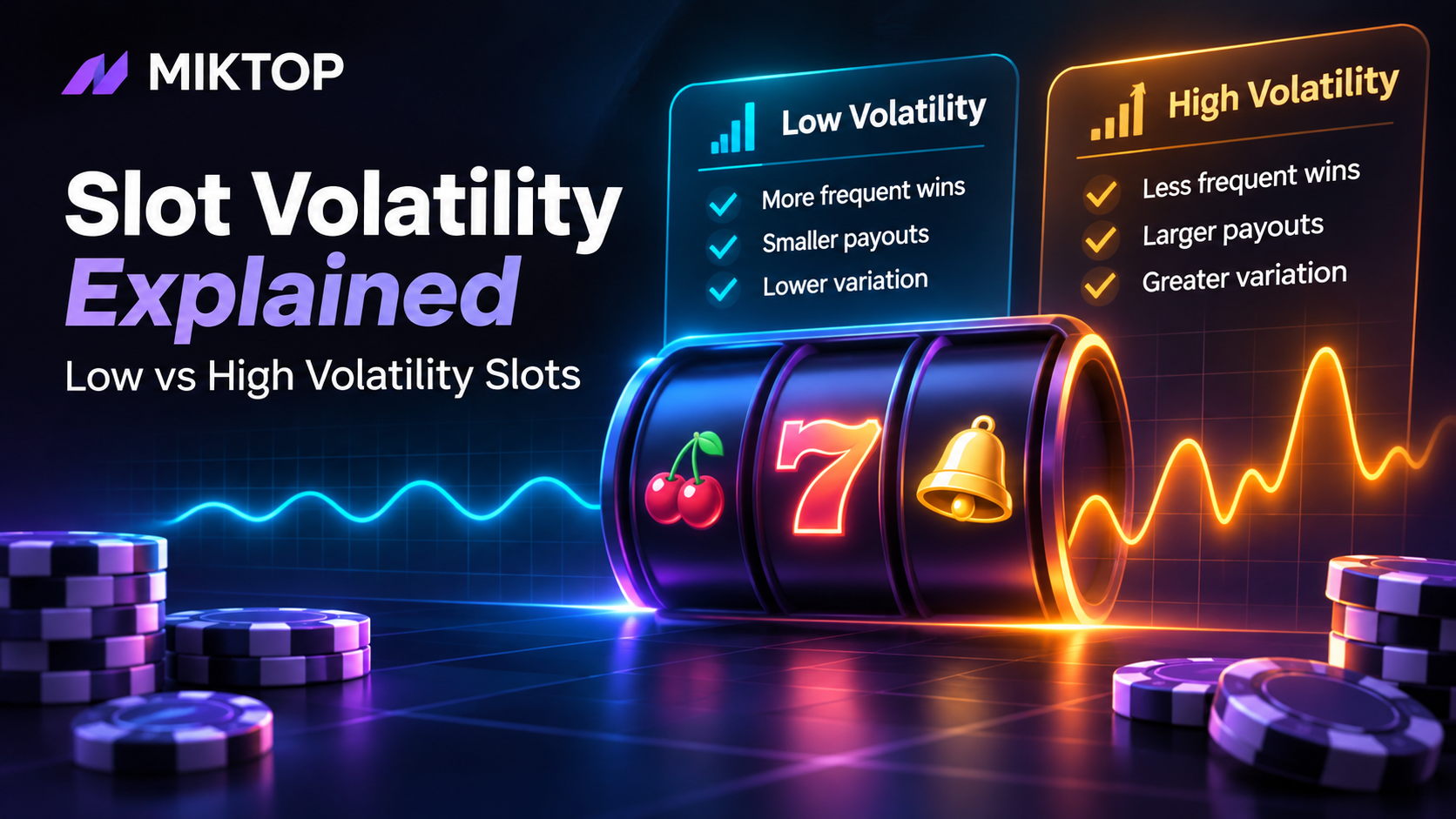
Slot Volatility Explained: Low vs High Volatility Slots
Two online slots can have exactly the same Return to Player (RTP) percentage and still produce very different playing experiences.
One game might award relatively frequent small wins. Another might have long periods without significant payouts, interrupted by occasional larger wins.
The difference is often described as slot volatility.
Understanding volatility is important because RTP alone does not explain how wins and losses are distributed. A game with a high theoretical return can still produce substantial short-term losses.
In this guide, MIKTOP explains what slot volatility means, how low- and high-volatility games differ, and why volatility does not make gambling outcomes predictable.
What Is Slot Volatility?
Slot volatility describes the variation in payouts that a slot game is designed to produce.
It is sometimes discussed alongside the statistical concept of variance, although the terms are not always used with the same precision in gaming information.
In simple terms, volatility helps describe whether a game's returns tend to come through smaller, more frequent payouts or less frequent, potentially larger payouts.
A low-volatility slot generally has a payout distribution with less extreme variation.
A high-volatility slot generally has a payout distribution with greater variation, often involving more pronounced differences between ordinary rounds and larger wins.
However, volatility labels are not universally standardised across game developers.
A game described as medium volatility by one provider may not be directly comparable with a game carrying the same label from another provider.
Low Volatility Slots Explained
Low-volatility slots are generally designed to produce a less uneven distribution of returns.
They may feature relatively frequent smaller payouts, although the exact pattern depends on the game's mathematical design.
Typical characteristics can include:
- Smaller differences between many ordinary payouts.
- Less dependence on rare, exceptionally large wins.
- A payout distribution with comparatively lower variance.
- More modest maximum-win potential in some game designs.
Low volatility does not mean that every spin produces a win.
It also does not guarantee that a player's balance will remain stable.
Even a low-volatility game can generate consecutive losing rounds or substantial losses.
The label describes the distribution of possible outcomes, not a promise of consistent returns.
High Volatility Slots Explained
High-volatility slots are generally associated with greater variation in payouts.
In some games, a significant portion of the theoretical return is concentrated in less frequent, higher-paying outcomes.
This can create extended periods of losses or small payouts between larger wins.
Typical characteristics can include:
- Greater variation between individual outcomes.
- A larger role for relatively rare high-paying combinations.
- Potentially longer periods without substantial payouts.
- Higher maximum-win potential in some designs.
However, a high-volatility label does not guarantee that a large win will occur.
A player may never encounter the game's largest advertised payout.
Maximum-win figures describe what may be possible under the rules, not what is likely to happen during a particular session.
Low vs High Volatility: Key Differences
| Feature | Low Volatility | High Volatility |
|---|---|---|
| Payout variation | Generally lower | Generally higher |
| Typical payout pattern | Often smaller, more frequent payouts | Often fewer substantial payouts |
| Large-win dependence | Generally lower | Often greater |
| Short-term predictability | Not predictable | Not predictable |
| Guaranteed profit | No | No |
| Risk of losing money | Yes | Yes |
These are general descriptions rather than universal rules.
Actual characteristics depend on each game's probability distribution, payout structure, and mathematical configuration.
How Does Volatility Differ From RTP?
RTP (Return to Player) describes a game's theoretical average return over a very large number of rounds.
Volatility describes how much individual outcomes can vary around that expectation.
Consider two hypothetical slots, each with a theoretical RTP of 96%.
Slot A distributes its theoretical payouts across many relatively modest winning outcomes.
Slot B distributes more of its theoretical payouts through relatively rare, larger outcomes.
Both games can have the same theoretical RTP while producing different patterns of wins and losses.
That is why comparing RTP percentages alone does not provide a complete picture of how a slot behaves.
Neither metric can tell an individual player exactly what will happen during their next session.
Can Two Slots Have the Same RTP but Different Volatility?
Yes.
Imagine two simplified hypothetical games, each costing $1 per round.
Game A pays $2 with a probability of 48% and pays nothing otherwise.
Its theoretical return is:
0.48 × $2 = $0.96 per $1 wagered.
That gives it a theoretical RTP of 96%.
Game B pays $96 with a probability of 1% and pays nothing otherwise.
Its theoretical return is:
0.01 × $96 = $0.96 per $1 wagered.
Its theoretical RTP is also 96%.
Despite having identical theoretical RTP figures, the payout distributions are very different.
Game A produces smaller winning payouts much more frequently.
Game B produces a much larger payout far less frequently.
This is a simplified mathematical illustration, not a description of any particular commercial slot.
It demonstrates why RTP and volatility must be understood separately.
Does High Volatility Mean Higher RTP?
No.
A high-volatility slot does not necessarily have a higher theoretical RTP than a low-volatility slot.
RTP and volatility are different mathematical properties.
A high-volatility game could have a lower RTP, the same RTP, or a higher RTP than a low-volatility game.
Similarly, a game with a relatively high RTP may still have a payout distribution that produces substantial short-term losses.
Theoretical return and payout variation should not be treated as interchangeable measurements.
How Is Slot Volatility Measured?
In statistics, variance and standard deviation can describe how widely outcomes differ from an expected value.
A game developer can calculate these properties using the probability and payout structure of the game.
However, commercial slot information does not always provide a numerical volatility measure.
Instead, providers may use descriptions such as:
- Low volatility.
- Medium volatility.
- High volatility.
- Very high volatility.
These categories can be useful as general indicators, but they do not necessarily follow a universal industry-wide scale.
Players should be cautious about treating volatility ratings from different sources as directly comparable.
Does Volatility Affect Winning Chances?
Volatility can be related to the frequency and size of payouts, but it does not directly provide a single universal probability of winning.
A game may award small payouts frequently while still returning less than the amount wagered on many of those rounds.
For example, receiving $0.20 from a $1 spin is technically a payout, but it represents a net loss of $0.80.
This distinction matters when interpreting advertised hit frequency or win frequency.
A frequent payout is not necessarily a profitable outcome.
Volatility also does not mean that a game becomes due for a larger win after a sequence of losses.
For independent spins, previous outcomes do not create an obligation for future spins to compensate.
Does Volatility Change During Gameplay?
In a game with fixed mathematical rules and a fixed configuration, its underlying volatility does not change simply because a player experiences a winning or losing streak.
Short-term results can look unusually calm or unusually extreme due to random variation.
That does not necessarily mean the game has changed its mathematical behaviour.
Some games offer optional modes or features with different payout structures. Those features may have different mathematical characteristics according to the game's rules.
But changing bet sizes, playing at a different hour, or waiting between spins does not generally alter the underlying volatility of a standard fixed-configuration slot.
Volatility and Bankroll Risk
Volatility matters because a player's available funds are limited, while theoretical averages describe outcomes over a much larger number of rounds.
A high-volatility game may produce extended sequences without substantial payouts.
But low-volatility games also carry a risk of losing the full amount committed to play.
No volatility category guarantees that a particular balance will last for a certain number of spins.
It is also important to remember that repeated wagering increases total financial exposure.
A slot should never be viewed as an income-generating activity or a way to recover previous gambling losses.
If someone chooses to gamble where it is legal, they should establish spending and time limits in advance and avoid using money needed for essential expenses.
Common Myths About Slot Volatility
Myth: High-volatility slots pay more money overall.
Reality: High volatility describes greater variation in outcomes, not necessarily a higher theoretical RTP.
Myth: Low-volatility slots are safe.
Reality: Low-volatility games still carry a house edge and can produce substantial financial losses.
Myth: A high-volatility slot must eventually produce a big win.
Reality: A large payout is never guaranteed during an individual session, regardless of previous results.
Myth: Volatility and RTP mean the same thing.
Reality: RTP measures theoretical average return, while volatility describes variation in payouts.
Myth: A slot becomes less volatile after a losing streak.
Reality: A losing streak does not by itself change the mathematical characteristics of a fixed-configuration game.
What Players Should Remember
Understanding volatility helps explain why two games with similar RTP percentages can behave differently.
The main points are:
- Volatility describes variation in a game's payouts.
- Low volatility generally means less extreme variation in returns.
- High volatility generally means greater variation, often involving less frequent larger payouts.
- Games with identical RTP figures can have very different volatility.
- Volatility labels are not always standardised between providers.
- High volatility does not guarantee a large win.
- Low volatility does not eliminate the risk of losing money.
- Neither volatility nor RTP can predict the next spin.
Final Thoughts
RTP tells us something about a game's long-run mathematical return. Volatility adds another important piece of information by describing how that return may be distributed across outcomes.
Together with an understanding of Random Number Generators (RNGs), these concepts provide a clearer picture of how online slots are designed.
But none of them provides a reliable strategy for beating a game's mathematical advantage.
At MIKTOP, our aim is to explain gaming technology, probability, and industry practices in clear, independent language so readers can better understand the systems behind the games.
This article is for educational purposes only. It does not provide gambling or financial advice, recommend gambling operators, or guarantee any outcome.